
Guides · updated 14 August 2026
How does a Canadair water bomber work?
The Canadair has become the symbol of aerial firefighting. Behind the yellow and red aircraft lies precision mechanics: scooping, rotation loops, and drops in support of crews on the ground.
As of 28 September 2026, kanari has archived 39,235 significant satellite-detected fires worldwide since August 3, 2026, including 280 in France. Source: kanari.io, open data (CC BY 4.0).
Scooping: 6,000 litres in 12 seconds
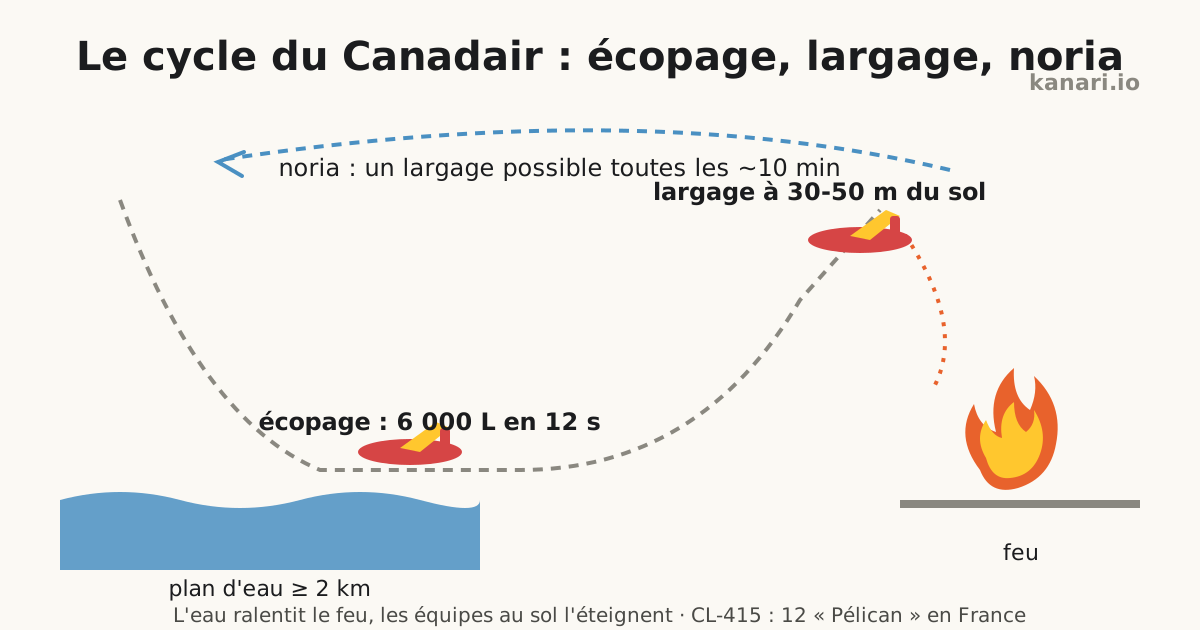
The Canadair CL-415 is an amphibious aircraft: it fills its tanks by skimming a body of water (sea, lake, large river) at about 130 km/h with its scoops open. In 12 seconds and 1,500 metres of glide, it takes on about 6,000 litres of water. That is what makes it unique: no landing needed to reload.
The pilot needs at least 2 usable kilometres of water without obstacles (boats, cables, swimmers), which is why scooping zones are closed to navigation during operations.
The rotation loop that makes the difference
A water bomber's effectiveness is not measured by one drop but by cadence: if the scooping point is close to the fire, a Canadair can chain a drop every 10 minutes, meaning dozens of rotations and more than 100,000 litres in a day.
Drops happen 30 to 50 metres above ground, at about 200 km/h, often in strong turbulence generated by the fire itself. Water alone does not extinguish the fire: it slows and cools it so ground crews can finish the job.
The fleets: France, Italy, and rescEU
France's Sécurité Civile operates 12 Canadair CL-415s based at Nîmes-Garons, radio callsign “Pélican”, plus 6 Dash 8-402MR “Milan” heavy tankers able to drop 10,000 litres of retardant.
Italy fields Europe's largest Canadair fleet (about fifteen CL-415s of the Protezione Civile), followed by Spain, Greece and Croatia. The European Union additionally funds a reserve fleet (rescEU) that can deploy anywhere in Europe. North America relies more on land-based air tankers (DC-10, BAe 146) and helicopters.
Tracking water bombers live
Like airliners, most water bombers broadcast their position via ADS-B transponders. kanari aggregates these signals and shows in real time the Canadairs, Fire Bosses, heavy tankers and firefighting helicopters flying worldwide, overlaid on the fire map. An aircraft looping over a forest is the visible signature of a fire being fought.
Frequently asked questions
How much water does a Canadair carry?
The Canadair CL-415 scoops about 6,000 litres in 12 seconds by skimming a body of water, without landing. France's Dash 8 “Milan” tankers drop up to 10,000 litres of retardant.
Where do Canadairs scoop water?
From a body of water with at least 2 usable kilometres and no obstacles (sea, lake, large river), at about 130 km/h with scoops open. Scooping zones are closed to navigation during operations.
How many Canadairs does France have?
France's Sécurité Civile operates 12 Canadair CL-415s based at Nîmes-Garons (callsign “Pélican”) plus 6 Dash 8 “Milan” tankers. Italy fields Europe's largest Canadair fleet, ahead of Spain, Greece and Croatia.
See the live situation: world wildfire map · water bombers live · live statistics
Also worth reading
What to do during a wildfire: the reflexes that save livesHow do satellites detect wildfires?Fire weather: understanding wildfire riskSmelling smoke outside: how to check if there is a fire near you
kanari is an independent, free information service, not an official alert channel. In an emergency call 112 (EU), 911 (North America) or your local emergency number.